Monday, April 18, 2016

The Ancient Greeks Knew... (Part 2)

Edited and Updated 20 April 2016

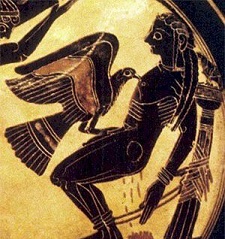
In the first part I brought to you several ancient epigraphy illustrations showing the different manner in which Prometheus was bound to the cliff in the Caucasus mountain range. Two of these show the Titan god to be impaled, or bound to look like he was impaled: through the rectum or perineum, out the back.


The illustrations which show the motif of Prometheus bound to a stake, or pillar, are repeated in Hesiod’s (760-650 BCE) Theogony 521, in which one of the gods carrying out the immobilizing of Prometheus instructs the other to fix a pillar in its place, driving it through the middle of… something:
For this lot Zeus assigned to him. And ready-witted Prometheus he bound with inextricable bonds, cruel chains, and drove a shaft through his middle, and set on him a long-winged eagle upon him, which used to eat his immortal liver; but by night the liver grew as much again every as the long-winged bird devoured in the whole day.

ταύτην γάρ οι μοῖραν ἐδασσατο μετίετα Ζευς. δῆσε δ΄ ἀλυκτοπέδῃσι Πρροομηθέα ποικιλόβουλον δεσμοις ἀργαλέοισι μέσον δια κίον ἐλλάσσας: καί οί ἐπ΄ αἰετὸν ὥρσε τανύπτερον: αὐτὰρ ὅ γ΄ ἧπαρ ἤσθιεν ἀπὰνατον, τὸ δ΄ ἀέξετο ἵσον ἀπάντη νυκτός ὅσον πρόπαν ἧμαρ ἔδοι τανυσιπτερος ὄρνις. [1]
Now in the above English translation (Hugh G. Evelyn-White) the scene depicted includes an impalement, which the Greek apparently includes. Part of the second sentence reads, δῆσε δ΄ ἀλυκτοπέδῃσι Πρροομηθέα ποικιλόβουλον δεσμοις ἀργαλέοισι μέσον δια κίον ἐλλάσσας (and he bound in unbreakable bonds the wily-minded Prometheus in painful chains he drove a stake through the middle). Now my English literal translation loses some of the apparent preciseness of the Greek, for “the middle” could be interpreted as the middle of the bonds and chains. This is also true of John Bowden’s English and Martin Hengel’s German because Hengel mentions that Hesiod “speaks of a post or pillar to which the god is fastened.” [2] Despite both Πρροομηθέα (Prometheus) and μέσον (the middle [of]) being in the singular masculine accusative sense, i.e., being the direct object or pertaining thereto, some ancient Greek artists clearly depicted Prometheus as bound to a pole or column with the bonds (usually ropes or leather strips) around it. So we can conclude that the Classical Greek was just as ambiguous, too; either that or the producers of ancient Greek art did not want to offend their contemporary purchasers.

Now we mention the images of Prometheus being “crucified” (although a cross, or tropaeum, is nowhere to be found), which go back to at least 350 BCE: there are a few writers (Lucian of Samosata [120-180 CE], Martial [38/41-102/104 CE], Apollodorus [b. 180 CE], Ausonius [310-395 CE]) who expound on or allude to the theme of Prometheus as “crucified.” [3] In his Prometheus, Lucian is very colorful in his writing style, he uses virtually every Greek verb known for executionary suspension, particularly that employed by the Romans in his time.

Aeschylus (525-456 BCE), too, has crucifixion-like imagery in his shackling of Prometheus to the rock:
Therefore on this joyless rock you must stand sentinel, erect, sleepless, your knee unbent.

ἀνθ΄ ὧν ἀτερπῆ τήνδε φρουρήσεις πέτρον όρθοστάδην, ἄυπνος, οὐ κάμπτων γόνυ: [4]
The imagery invoked in this text appears similar to that shown by a typical crucifix or in terrible movies like Mel Gibson’s The Passion of the Christ with the legs stretched out almost almost straight and the feet nailed through their arches into a triangular-shaped, sloped “plinth” (suppedaneum).

And Aeschylus refers to Prometheus’ using the verb paschô (πάσχω), which comes from the same root as the Latin passio, from whence comes our word, passion, which Christians use to refer to the suffering of Jesus in The Crucifiction.
See what I, a god, suffer at the hands of Gods!

ἴδεσθέ μ΄ οἷα πρὸς θεων πάσχω θεὸς [5]
Well now we get to discuss the final images, where the immobilized Titan appears to be impaled. We have already seen above Hesiod’s reference in Theogony to the κίον (kion) as a “shaft driven through his middle” in Evelyn-Whit’s translation in English [1]. Apparently Aeschylus interpreted Hesiod’s reference as some kind of steel or steel-like wedge to be driven into or through Prometheus:
Now vigourously pin the remorseless point of an adamantine wedge right through his bosom!

ἀδαμαντίον νῦν σφηνὸς αὺθάδη γνάθαν στέρνων διαμπὰξ πασσάλευ΄ ἐρρωμένως. [6]
Now there is no indication which direction this wedge [7] was to be driven, whether from below by way of the rectum or from the front like when killing a vampire, which more readily comes to mind in the English, and probably to a modern Greek as well.

But the ancient Greeks like Aechylus may have interpreted the σφην (sfên) as travelling through the body from the rectum and out, in this case, through the sternum or on either side of it, and not out through the back as per usual.

Actually Aeschylus does know of impalement, and he does know of it as torturing individuals (undoubtedly almost always men) with a slow, lingering death. From his Eumenides where the god Apollo chases the Furies out of his temple after they scare off a Pythian and have a dialogue with the ghost of Clymnestra:
This house is no right place for such as you to
Cling upon; but where, by judgment given, heads
Are lopped and eyes gouged out, throats cut, and
By the spoil of sex, the glory of young boys is
Defeated, where mutilation lives, and stoning,
And the long moan of tortured men spiked
underneath the spine and stuck on pales.

ούτοι δόμοισι τοίσδε χρίμπτεσθαι πρέπει·
άλλ' οΰ καρανιστήρες όφθαλμωρύχοι
δίκαι σφαγαί τε σπέρματος τ' άποφθορά
παίδων κακοϋται χλοΰνις, ήδ' άκρωνία,
λευσμός τε, και μύζουσιν οικτισμόν πολύν
υπό ράχιν παγέντες. [8]
That place where Apollo says the Furies belong was the βασανιστέριον (basanisterion), unique among the Greek cities and towns to Athens and possibly Miletus. [9] It was a place of public torture, a kind of stadium open to the public that was maintained for legal purposes, where the people gathered and watched people being tortured, to find out what was being said, according to Demosthenes. Indeed the Athenians prided themselves on their methods of examination by torture, thinking it to be “the justest and most democratic way” for the examination of slaves. [10]

In addition to the “torture-stadiums” the Athenians also kept public execution grounds where they killed their convicted criminals, [11] usually by ἀποτυμπανισμος (apotympanismos), a form of “planking” or “crucifying to a plank” using crimp-nails, including a collar around the neck, that could be loosened and tightened at will. But clearly other forms of executions occurred as well because the prisoners’ corpses were left lying about in these places. Indeed the Athenians must have been quite familiar, perhaps too familiar, with these people’s suffering. [12] And judging by Aeschylus’ verse, the Athenians knew that those who were impaled often suffered a slow, lingering death, and offered up a long moan; or, if I may translate more literally, “they even moan[ed] piteously many a long lamentation” (και μύζουσιν οικτισμόν πολύν).

Another Classical Greek writer familiar with impalement was Euripides (480-406 BCE) who in Rhesus describes a scene wherein the protagonist Rhesus mentions to his dialogue partner, the Trojan commander Hector, that he was going to impale and hang alive a certain criminal waiting for him in ambush:
If I can catch this knave alive,...
I will impale him at the outlet of the gates
and set him up for vultures of the air to make their meal upon.
This is the death he ought to die,
pirate and temple-robber that he is.
(My translation following E. P. Coleridge’s)

This one …, I will take alive
and at the gates' outlet impale through the spine
and set up as a feast for winged vultures.
Being a robber and plunderer of the temples of the gods
he ought to die through this fate
(David Kovacs’ translation)

τουτον -- -- ζωντα συλλβων εγώ
πυλων επ' εξόδοισιν ευπείρας ράχιν
στήσω πετεινοϊς γυψι θοινατήριον'
ληστην γαρ οντα και θεων ανάκτορα
συλωντα δεϊ νιν τωδε κατθανεϊν μόρω [13]

Here Euripides exhibits knowledge that death by impalement could come about over a long period of time, not just by the shock and bleeding from the piercing of the body ‘neath the spine but also because of the additional suffering of being molested and partly consumed alive by birds. Hermann Fulda in his Das Kreuz und die Kreuzigung cites this example to show that impalement by way of the buttocks (i.e., rectum, anus) were to be understood as under the ῥάχις (rakhis) “spine, chine, tailbone” or in Latin, obscoena “the private parts / excrements [entrails],” and (although not mentioned in this example) the pole was not pushed through the full length of the body so that one had the opportunity of speaking of one so impaled as “sitting on a cross.” [14] So here Fulda understood that impalement could cause the suspended person to suffer a long death struggle, so long as certain provisions were taken to prevent the piercing of vital organs or the nicking of vital blood vessels.

Next we have a (likely Athenian) Middle and New Comedy poet / playwright by the name Alexis (Hellenistic Era, ca 375 - ca 275 BCE). In his The Parasite it appears that we have chanced upon a bit of an ancient equivalent the Comedy of the Absurd. This sort of comedy was not unknown to the Romans (who got a lot of their ideas and attitudes and social conventions from the Greeks) as evidenced in Plautus’ play Mostellaria. [15] Now the last line of Alexis’ fragment of what is believed to be known as The Parasite, describes a punishment an enraged speaker wishes to visit upon the parasite (and one Theodotus, too): “transfix [him] upon The Wood” (άναπήξαιμ' έπι τοΰ ξύλου):
Otherwise when you must bind the cheat Theodotus,
or the parasite so that I have known the profane
playing the prude, the ones in white and the taking up of mattocks [i.e., pick-axes],
pleasant if I were to seize [them] and transfix [him] up {through him} upon The Wood.

άλλ' έπάν δή τον γόητα Θεόδοτον,
ή τον παραμασύντην ϊδω τον άνόσιον
βαυκιζόμενον τα λευκά τ' άναβάλλονθ' άμα,
ήδιστ' άν άναπήξαιμ' {άν αύτον} έπι του ξύλου λαβών. [16]
Like the rest of his text, the translation and interpretation is rather awkward. The verb άναπηγνύναι (anapêgnunai) is defined as “to transfix, impale.” [17] But the problem is that the transfixing is to take place upon The Wood (τὸ ξύλον [to xylon]), which in the Athens of the time probably did not refer to an impaling stake but some other kind of trimmed or fabricated wood instrument. The awkwardness and discrepancies in this verse was noticed by W. Geoffrey Arnott of Cambridge University and concludes that “in Alexis here the use of άναπήξαιμ' (anapêxaim) and the general tone of anger suggest something more vicious than whipping in the stocks or pillory: perhaps ἀποτυμπανισμος where a criminal was executed by being fixed naked to an upright plank on which iron bands encircled ankles, wrists and neck.” [18] If so, then the use of the verb suggests something more cruel and unusual, like a Roman penalty instead: i.e., “crucifying” on a plank with real nails and not those crimp-nails the Greeks usually used. But this, too, like impalement was an un-Attic penalty. It suffices to say, though, that transfixing a person with The Wood would have been patently absurd, just like those illustrations of Prometheus that appear to depict him impaled. Hence Alexis would have gotten a big laugh and a standing ovation at the end.


Now we take a look at two lexicographers from the Byzantine Era (5th and 12th Centuries CE), who compare the nouns σταυρὸς, σκόλοψ and χάραξὸς and their derived verbs. Nowhere have I found any English translation of their definitions in Byzantine Greek, but I did find Latin translations in Justus Lipsius’ De Cruce, which was some help to me in coming up with my own translations.

First is Hesychius of Alexandria (5th C. CE), from his Alphabetical Collection of All Words.

(1) Stauroi, those planted pointed stakes, palings
(2) Skolopes, upright and sharp timbers, pales/poles, palings. 
(3) Kharaksi, fencings-in, with sharp timbers, and with reedy pipes/vine stakes, and those pales/poles.
(4) Keleontes, [in Antiphon are briefly rendered] upright timbers. 

(1) Σταυροί, οί καταπεπηγότες σκόλοπες, χάρακες·.
(2) Σκόλοπες, ὀρθέα (I. ὀρθὰ) καὶ ὀξέα ξυλα, σταυροί, χάρακες·
(3) Χάραξι, φραγμοῖς, ὀξέσι ξύλοις οί δέ, καλαμοις, οι δέ, σταυροῖς.
(4) Kελέοντες [in Antiphon are briefly rendered] ὀρθα ξυλά [19]
He comments in his Etymologus, concerning the noun κελέοντες. It isn’t how the noun came about or where it came from, just how it is misused.
Keleontes, those long beams which govern a loom, [is] misused and even those planted timbers, they [the people] call these and stauroi.

κελέοντες, κυριως οί ἱστόποδες, καταχρηστικῶς δὲ καὶ τὰ καταπεπηγότα ξυλα, ά καὶ σταυροὺς καλοῦσι. [20]
Also in his Etymologus he gives us a clear relationship between the noun σκόλοψ (skolops) and the verb ἀνασκολόπιζω (anaskolopizô), and makes the meaning of the verb clear by comparing it with the roasting of fishes on spits:

On skolopes as a roast: for in olden times those dealing basely were impaled, a sharpened stake along the spine and [through] the back, just like those roasted fish on spits.

Σκόλοψιν ὡς ὅπτησιν τό γαρ παλαιό ν τούς κακούργου ντας άνεσκολόπιζον, όξύνοντες ξύλον δια τής ραχέως και τού νώτου, καθάπερ τούς όπτωμένους ιχθύς έπι οβελίσκων. [21]

In the above description, the location within the impaled could also be interpreted as “past / through the tailbone and the back” with no interpolation necessary. [22] And as noted above, “past the tailbone” would be understood as under it, i.e., through the rectum, the back passage. This of course probably was the same route the Turks used in Egypt and elsewhere to avoid lethal damage to any critical blood vessels or vital organs, resulting in a slow, lingering death.

Unfortunately Hesychius’ information is the only place where the verb ἀνασκολόπιζω is connected to the noun σκόλοψ, and is clearly explicit that the verb referred to impaling, probably because at the time of Hesychius, people were being executed by being skewered on spits. [23] Modern scholars today may see this linkage that this is a case of Byzantine-era etymological fallacy, in this case the projection of contemporary times upon the past: all other mentions of this verb, particularly ones that antedate this one, do not make the linkage. Unfortunately, Hesychius does not tell us whether this method of execution resulted in a slow, lingering death, or in a quick, messy death.


Finally we have Eustathius of Thessalonica (1115-1195 CE), a late Byzantine / mid-Mediaeval grammarian who produced his Commentaries on the Iliad and Odyssey. In three places he discusses the nouns σταυρὸς (stauros) and σκόλοψ and in two of those places links them with the verbs ἀνασταυροω (anastauroô) and ἀνασκόλοπιζω and claims the verbs are derived from the nouns:
Skolopes are called these of such a kind, and stauroi – and from these [derive] the verbs anaskolopizeiv and anastauroun.

σκόλοπες λέγονται δὲ οἱ τοιτοῦτοι σκόλοπες καὶ σταυροὶ -- ἐκ δὲ τούτων τὸ ἀνασκολόπιζειν, καὶ ἀνασταυροῦν. [24]

Stauroi: upright and sharpened timbers. But these themselves are called by this, and skolopes; from these [derive] the [verbs] anaskolopizesthai and anastaurousthai.

Σταυροὶ ὀρθὰ καὶ ἀπωξυμμένα ξύλα. -- οἰ δ΄ αὐτοὶ καὶ σκόλοπες λέγονται,ἀφ΄ ὧν τὸ ἀνασκολόπιζεσθαι, καὶ ἀνασταυροῦσθαι. [25]
Here in this work in two places (comments on Iliad ή.441 and Odysseus ώ.452-3) Eustathius clearly states that two Classical-Koine-Byzantine Greek verbs for executionary bodily suspension, commonly meaning “impale” and “crucify (again)” in modern English, came from their respective nouns; not only that, but also because the nouns refer to one and the same kind of pole – sharpened timbers. The verbs, too, apparently in his time referred to one and the same action – suspend on sharpened timbers, that is, impale -- despite today having entirely different senses. And in the third place he confirms that in his time, stauros and skolops were two words for one and the same thing – and they weren’t crosses:
But skolopes even now [are] upright timbers, these and stauroi.

Σκόλοπες δὲ καὶ νῦν ξύλα ὀρθα, οἱ καὶ σταυροί. [26]
This is Eustathius’ comment on Homer’s Odysseus η. 44, which describes “Tall walls” as “Fit together with upraised stakes” (Τείχεα μακρὰ … Ὑψηλὰ σκολόπεσσιν ἀρηρότα [Teikhea makra … Ypsêla skolopessin arêrota]). So even in the Late Byzantine - Mid Mediaeval time of the 12th Century ce, we have a clear indication that the stauros and skolops, outside of the Church and outside of the Greek Orthodox Bible, meant only one thing: an upright pale or stake, with no transom indicated. Additionally, the derived verbs would probably have meant, as in Hesychius’ time the 5th Century CE, to suspend on an upright pale or stake, i.e., impale.

So, in conclusion, we can plainly see both from the extant artwork and epigrams that the Greeks, possibly as late as the 5th Century CE and even the 12th and beyond, probably knew, and most certainly did know according to Aeschylus and Euripides, that it was possible to execute someone by impalement, and have that action result in a slow, lingering death. This, of course, is contrary to the conclusions made by certain scholars today!

_________________________

Notes:

       [1] Hesiod, Theogony 520-5, Hesiod. The Homeric Hymns and Homerica. With an English Translation by Hugh G. Evelyn-White. Cambridge, Mass: Harvard Univ. Press; London: William Heinemann, Ltd. (1914), page unknown. Cited in: Gunnar Samuelsson, Crucifixion in Antiquity. Tübingen: Mohr Siebeck, (2011), p. 69.
       [2] Martin Hengel, Crucifixion, trans. by John Bowden. Philadelphia: Fortress Press (1977), p. 11 n. 1, the English of δεσμοις ἀργαλέοισι μέσον δια κίον ἐλλάσσας reads, “bound with inextricable bonds, driving a shaft through the middle.” 
       [3] Ibid., pp. 11 n. 1, 2 n. 2, and 58 n. 13. For further investigation see the references cited by Hengel, to wit: Lucian, Prometheus 1-2, 7, 10, 12, 17; Apollodorus 1.7.1; Iuppiter confutatus 8, De sacrifiis 6, and Dialogi deorum 5(1).1; Martial, Liber spectaculorum 7.1ff; and Ausonius, Technopaegnion (De Historia) 10.9ff. See also Lucian’s Prometheus 4, 9 and 15. The extant Greek texts are available for viewing and downloading at the Perseus Digital Library (PDL), Latin at the PDL and The Latin Library.
       [4] Aeschylus, Prometheus Bound 31. From Aeschylus, with an English translation by Herbert Weir Smyth, Ph. D. in two volumes. Vol. 1, Prometheus Bound. Herbert Weir Smyth, Ph. D. Cambridge, MA. Harvard University Press. 1926 (found at PDL).
       [5] Ibid., 93. Trans. mine.
       [6] Ibid., 64-5. Trans. mine.
       [7] From the Perseus Greek Word Study Tool (PWGST), referencing the LSJ and Middle Liddell lexica, we have this for σφηνὸς: it is the genitive of σφην (sfên), “wedge, shim, plug.” It is related to σφην-εύς (sfên-eüs), “mullet-like fish”; σφην-ισκος (sfên-iskos), “wedge-shaped nostril plug, irregularly truncated pyramid”; σφιγ- (sfêig), “related to binding, nooses, sphincters, constipation, sphinx, bracelet, greed”; σφην-οω (sfên-oô), “shape like a wedge, to be cloven with a wedge, inlaid, fix by means of a wedge, to become fixed like a wedge, plug up, close up, close, catch cold in the head, obstruction, torture, rack” (the last two in Plutarch An vitiositas 2.498D). The fact that this word σφην is related somewhat to the ancient Greek for “sphincter”, and the fact that the references to “torture, rack” in the derived verb could refer what the Inquisition called the Judas Chair or in Italy il cavaletto, might be a clue that the wedge was an item meant to enter the person through the anus.
       [8] Aeschylus, Eumenides 185–190. Aeschylus. With an English Translation by Herbert Weir Smyth, 2 vols., LCL. London: William Heinemann; New York: G. P. Putnam's Sons (1922), page unknown. Cited in: Eva C Keuls, The Reign of the Phallus. Sexual Politics in Ancient Athens. Berkeley - Los Angeles – Oxford: University of California Press (1993), pp 8-9.
       [9] Keuls, p. 7.
       [10] Lycurgus 29, quoted in Keuls, p. 7.
       [11] Keuls, p. 8.
       [12] Plato, Rep. 4.439e, cited in Keuls, p. 8.
       [13] Euripedes, Rhesus 513-7, original Greek cited in Hermann Fulda, Das Kreuz und die Kreuzigung, Breslau, Wilhelm Koebner, 1878, p. 114. First transl. mine, following The Plays of Euripides, transl. by E. P. Coleridge, Volume I, London. George Bell and Sons (1891), page unknown (found at PDL). Second transl. from Euripides. With an English Translation, by David Kovacs, LCL, Cambridge, Mass. Harvard University Press (1994), page unknown, cited in: Samuelsson, p. 72.
       [14] Fulda, p. 114.
       [15] Here (Plautus, Mostellaria 359ff; transl. by John Bowden, in: Hengel, Crucifixion, p. 52 n. 3) the slave Traino believes he has found himself in a bit of a pickle, and expresses his willingness to pay someone to take his expected penalty for him:
Ego dabo et talentum primus qui in crucem excucurrerit;
sed ea lege, ut offigantur bis pedes, bis bracchia.
Ubi id erit factum, a me argentum petito praesentarium.

I’ll give a talent to the first man to charge my cross and take it
on the condition that his legs and arms are double-nailed.
When this is attended to he can claim the money from me cash down.
This is a clear case of an ancient comedy of the absurd. How would his place-taker accept the talent (about 200 Pounds Sterling in Victorian days) of precious metal if both his hands and both his feet are secured with two nails each?
       [16] Alexis (The Parasite), 224.10 (222.10 as cited in the LSJ listing (s.v άναπήγνυμι) in the Perseus Greek Word Study Tool and the PDL), transl. mine.
       [17] This LSJ listing includes at least two citations for demonstrating the first person singular sense of the verb (άναπήγνυμι) as “I transfix, impale”: Aristophanes Ecclesiazusae 843a (λαγῷ΄ αναπηγνύνασι, “they are spitting the hares”) and Plutarch Artaxerxes 17.5 (διὰ τριῶν σταυρῶν ἀναπῆξαι, “impaled across [lit.: through] three pales”).
       [18] W Geoffrey Arnott, Alexis: The Fragments: A Commentary. Cambridge, UK: Cambridge University Press (1966), p. 645.
       [19] Hesychius, Alphabetical Collection of All Words, s.v. Σταυροί.
       [20] Hesychius, Etymologus ??.??
       [21] Hesychius, Etymologus 100.51
       [22] LSJ, s.v. “ῥάχις” at PDL and PGWST.
       [23] Samuelsson, p. 284.
       [24] Eustathius, Commentaries on the Iliad and Odyssey, Iliad ή 441.
       [25] Ibid., Odysseus ξ.11.
       [26] Ibid., Odysseus η.44.


Saturday, April 9, 2016

The Ancient Greeks Knew...


Prometheus chained to a cliff in the Caucasus.
This is a more modern depiction, or at least resembles it.
Source: not known.

One thing about impalement that the Ancient Greeks knew that modern scholars (at those who have studied the topic of "crucifixion") don't seem to get, is that the executioners could run a stake right through a man and he would end up in the extended struggle of a slow, lingering death. Their knowledge of this can be clearly seen both in the epigraphy and the (ableit very rare) extant writings.

First, I have found various epigraphy of Prometheus fastened to some kind of stake, or frame, or "crucified" by being chained to a cliff face.

Here are two images showing Prometheus attached to a stake.

Here we see Herakles freeing the bound Prometheus from the stake just as the appointed eagle arrives to torment him.

Herakles freeing Prometheus.
Attic black-figure cup, c. 500 BCE
Source: Bibi Saint-Pol, Wikimedia Commons.
Next we have Prometheus shown bound by his hands to a pillar whilst being tortured by an eagle pecking at his heart; his blood is falling to the ground.

Early depiction of Prometheus bound to a pillar.
Laconian black-figure amphoriskos 6th C. BCE.
Source: Vatican City Museums, Theoi.com.
Next we have images of Prometheus chained to a cliff or frame, somewhat like a crucifixion.  In other words, we're dealing with a crucifixion of a god, just like Jesus Christ (allegedly) and Julius Caesar and other deified emperors (in imagine).

In this image below, Prometheus is depicted as "crucified" though with bent elbows to a cliff. he's standing on his tip-toes and his feet appear to overlap each other, like those of "Jesus" on the Shroud of Turin.  This image is clearly congruent with the imagery depicted in Lucian's Prometheus, and it may be where Lucian got his ideas of how the god was allegedly hanged.


 Heracles freeing Prometheus, who is "crucified" to a cliff. 
Relief from the Sebasteion at Aphrodisias.1st C. CE.
Source: Source: Hans Weingartz, Deutsch (German) Wikipedia.
 
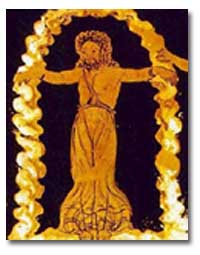
And here is Prometheus shackled to a upside-down-U-frame. His arms are spread out as if by a patibulum.
Depiction of Prometheus on a vase ca 350 bce.
Source: unknown.
 In both these depictions, Prometheus is secured to a U-frame, again, crucifixion-style.

But the next two depict (or at least imply) Prometheus as impaled.


Early depiction of Prometheus impaled on a stake.
Note the stake is absurdly flat-topped!
Black-and-white line drawing copy.
Source: not known.


Another early depiction from a plate or vase of Prometheus impaled on a stake.
Again, the impaling stake is flat-topped.
Source: Theoi.com.
In each of these two images above, the impaling stake appears to go through the rectum and out the back right behind the shoulders.  These images are essentially identical to the depictions of impalements by the Turks in Egypt and other areas they controlled, and by the Russians in about the 16th/17th Century.

Textual evidence later.

Tuesday, April 5, 2016

One of the things that throw scholars off...

 
... is the idea that impalement as a death penalty invariably ends with an immediate, or at least a quick, death.  Gunnar Samuelsson and John Granger Cook both hold this conviction. Yet sketches from the 16th, 17th and 18th centuries show that this was not so!

There was a way that the Turks -- and Vlad Țepeș (sometimes) -- did it; by transfixing the person through the length of his body from the rectum and out the back below one of the shoulders.  The Western Europeans of the time thought it was a disgusting and exceedingly vile combination of the utmost cruelty and "unnatural" "sex."


Scene of Barbaric Slavery.


Luyken Straf empaleren Egypten
Note one of the impalees is smoking a pipe!

Luyken Straf van het empaleren en Egypte.
Earlier version, same as above but the scenery is different.
Crucifixion d'un Chretien a Alger.
Crucifixion d'un Chretien a Alger - Detail.
Notice he's already been impaled ... and he's still alive!
Okay, this one above might have been penetrated between the spine and the skin, but the crookedness introduced into his body suggests otherwise:  if so, the stake would have to be routed next to the spine behind the descending aorta and the vena cava without nicking either vessel or piercing a vital organ. Not bloody likely, in my opinion. 

Impaled on a stake in Ceylon.
This man was obviously dead.

Scenes des supplices Asiatiques.
Impalement scene in 16th Century Russia.
The impale on the right is apparently smiling! :^O

Scenes des supplices.
Scenes des supplices - detail.
Note one of the impales is obviously alive by the positioning of his legs.

So you can see, if you impale someone with care, the victim will be transfixed to suffer extreme torture for a long, slow, lingering death.

I also found evidence that the ancient Greeks knew this was true, too; and included their knowledge thereof in epigraphs and literature... although very, very rarely.


Saturday, March 26, 2016

Earlier Christians confused the crux with the tropaeum.

In my last post posted on Thursday the 23rd, the day before dies sanguines or Good Friday, which annually commemorated the Passion and Crucifiction of Jesus Christ, I indicated what the earliest ROMAN Catholic-Orthodox Christians believed about the most central event of Christianity (apart from the Resurrection). Apparently there were two separate traditions concerning how the suspension of the Son of God appeared, one that goes back to a relief on the doors of Santa Sabina Cathedral in Ravenna, IT, apparently based on depictions of the Three Boys in the Fiery Furnace of Daniel 3 as orants (orant, from the Latin orans), and another that goes back to the Sarcophagus Domatilla where the crux itself was modeled on the Roman tropaeum and itself eas carried about just like a tropaeum.


Now, if we go further back in the record (despite the fact that Christianity as we know it -- the one based on the Nicene creed -- only goes back to 325 CE), we will encounter a derogatory graffito scratched out during the government of Alexander Severus and the confusions promulgated by three writers known as "Church Fathers".  First the Graffito:


A slight description of the graffito: "Alexamenos worships his god" (or Alexamenos, worship God!) is the inscribed message, apparently in response to a nearby graffito that proclaimed, "Alexamenos, always faithful." It has been reliably dated to just after the turn of the 3rd C. CE, during the reign of Alexander Severus.

Note that not only the god that Alex is worshipping is made fun of. The devotee's method of worship is also being sneered at: he is hailing his god with his left hand, which is about in line with the level of his mouth, which is also at the level of his god's penis.  It appears that the tagger was thinking, Alexamenos is worshipping the virilia of his god. The god himself has a donkey's head, suggesting a very ample endowment. The god is also portrayed naked from the waist down, possibly implying that Alex is about to perform something more "worshipful" than a hailing from a distance. The Y next to the head of the god is very similar to metal defixiones (curse tablets) found in Rome, which had similar illustrations of a donkey's head next to a Y inscribed on one of the sides. Of course, this could mean that Alexamenos was not at all a Christian/Chrestian, but a devotee of Typhon-Seth.

Since not only Alexameno's god is portrayed in a derogatory manner, so is the manner in which the god has been crucified: on a T-shape cross, or tropaeum, complete with suppendaneum, instead of the usual pole equipped with a sedile/cornu.

And so we shall see if early "Church Fathers" confused the Roman crux (σταυρός)  with the Roman tropaeum (τροπαῖον).

First at bat: Minucius Felix (Octavius, ch. 29).

These, and such as these infamous things [such as worshipping the virilia of their priest or the nature, i.e., genitals of their father -- see Octavius, ch. 9], we are not at liberty even to hear; it is even disgraceful with any more words to defend ourselves from such charges. For you pretend that those things are done by chaste and modest persons, which we should not believe to be done at all, unless you proved that they were true concerning yourselves.

For in that you attribute to our religion the worship of a criminal and his cross, you wander far from the neighbourhood of the truth, in thinking either that a criminal deserved, or that an earthly being was able, to be believed God. Miserable indeed is that man whose whole hope is dependent on mortal man, for all his help is put an end to with the extinction of the man....

Crosses (cruces), moreover, we neither worship nor wish for. You, indeed, who consecrate gods of wood, adore wooden crosses perhaps as parts of your gods. For your very standards, as well as your banners; and flags of your camp, what else are they but crosses glided and adorned? Your victorious trophies (tropaea) not only imitate the appearance of a simple cross (cruces simplicis), [1] but also that of a man affixed to it.

Crucis simplicis is the genitive of crux simplex. From the epigraphy, what Minucius Felix regarded as a crux simplex (the frame of a tropaeum) was not the same as that item (a plain pole) defined as such. And Minucius is the one who is accusing the Romans of crux-worship.

Next at bat, Tertullian.

You put Christians on crosses and stakes: what image is not formed from [white] clay in the first instance, set on cross and stake? The body of your god is first consecrated on the patibulum!

Tertullian, Apologeticus 12:3
Patibulum here could denote a T-shape gibbet, or rather, cross, by Tertullian's understanding. And he says when the body of their god (like a divine Caesar) is first dedicated, it is installed on a patibulum, or cross, that is, a tropaeum. Just like in this miniature Caesarean tropaeum, on display at the Berlin Museum in Charlottenburg, Germany, below:


Note the ROMAN BREASTPLATE ARMOR on the tropaeum.

6 Then, if any of you think we render superstitious adoration to the cross (crux), in that adoration he is sharer with us. If you offer homage to a piece of wood at all, it matters little what it is like when the substance is the same: it is of no consequence the form, if you have the very body of the god. And yet how far does the Athenian Pallas differ from the stock of the cross, or the Pharian Ceres as she is put up uncarved to sale, a mere rough stake and piece of shapeless wood? 7 Every stake fixed in an upright position is a portion of the cross; we render our adoration, if you will have it so, to a god entire and complete (integrum et totum). We have shown before that your deities are derived from shapes modelled from the cross. But you also worship victories, for in your trophies (tropaea) the cross (crux) is the heart of the trophy (intestina tropaeorum). 8 The camp religion of the Romans is all through a worship of the standards, a setting the standards above all gods. Well, as those images decking out the standards are ornaments of crosses. All those hangings of your standards and banners are robes of crosses. I praise your zeal: you would not consecrate crosses unclothed and unadorned.

Tertullian, Apologeticus 16:6-8
Indeed, in the photo at the top, and the one just above, the "heart" of the tropaeum is indeed a cross. Now what for Tertullian is a crux integra et tota? Well he can explain.
Any piece of wood planted upright in the ground is part of a cross and indeed the larger part of a cross.  But we Christians are credited with an entire cross (tota crux) complete with a transverse beam (antenna) and [the well-known] projecting seat (ille sedilis excessu)

Tertullian, Ad Nationes 1.12.

Now at the link to the source above there is a note at the bottom of Ad Nationes I (1) chapter XII (.12) describing the projecting seat as a ledge, or bench. Other scholars, however, regard this piece to be a plank, beam, or peg: a sort of "phallus." So now we're not looking at a cross for the integra et tota crux (a crux uninjured and complete) executionary suspension device, but a T-pole apparently modeled after the Roman god Priapus.

No now we have a difference between the crux, commonly and almost universally to be regarded as a cross, and what actually was a cross: a tropaeum.

Third at bat, Saint Justin the Martyr.
But in no instance, not even in any of those called sons of Jupiter, did they imitate the being crucified; for it was not understood by them, all the things said of it having been put symbolically. And this, as the prophet foretold, is the greatest symbol of His power and role; as is also proved by the things which fall under our observation. For consider all the things in the world, whether without this form they could be administered or have any community. For the sea is not traversed except that trophy (τροπαίον) which is called a sail abide safe in the ship; and the earth is not ploughed without it: diggers and mechanics do not their work, except with tools which have this shape. And the human form differs from that of the irrational animals in nothing else than in its being erect and having the hands extended, and having on the face extending from the forehead what is called the nose, through which there is respiration for the living creature; and this shows no other form than that of the cross (σταυρός). And so it was said by the prophet, “The breath before our face is the Lord Christ.” And the power of this form is shown by your own symbols on what are called “vexilla” [banners] and trophies, with which all your state possessions are made, using these as the insignia of your power and government, even though you do so unwittingly. And with this form you consecrate the images of your emperors when they die, and you name them gods by inscriptions. Since, therefore, we have urged you both by reason and by an evident form, and to the utmost of our ability, we know that now we are blameless even though you disbelieve; for our part is done and finished.

Justin Martyr, I Apology 55

Justin Martyr notes that the "cross," or σταυρός, gives its form to the "trophy" (τροπαίον) that resides in a ship without which ships cannot sail, to the plough, and to the form where Romans dedicated wax images of their simultaneously deified emperors at their funerals (of course elsewhere [Dialogue with Trypho 91] he states that the actual execution device, the crux/σταυρός has the same shape that Tertullian credited it with, as we have seen).  According to Franceso Carotta, this Roman Imperial tradition of consecrating emperors at their funerals with the form of a cross began with the funeral of the first Caesar, the divine Gaius Julius Caesar.

Below are various interpretations of how Julius Caesar's wax image was displayed on a tropaeum. The first two images are clearly erroneous, showing the body of Julius Caesar in imago with his arms down at the sides and behind the antenna like some common suspended criminal. It is more likely, given that the Senate had already proclaimed him a god, that Caesar's was image would be displayed with his arms extended, as a sign of victory; but on the other hand, extending the arms would have displayed each and every stab wound that Caesar received when he was assassinated with dagger-wielding men in the temporary House of the Senate in Pompey's Theatre.  Thirdly, criminals suspended on cruces would not always have their arms down at their sides. Frequently, their arms would be extended along the device's transom, or patibulum (as well as a distinct beam or bar between two poles). So the crowd would have perceived Caesar's death as tantamount, or almost, to a Roman "crucifixion," that is, a suspension on some kind of T-pole (like our modern utility pole).


Source: the History Channel (Divvs Ivlivs blog).
Source: Sitsim (Divvs Ivlivs blog). 

The above images depict what I believe to be an erroneous interpretation of the display of the wax image of Julius Caesar on a tropaeum.


Source: Francesco Carotta, Jesus Was Caesar.

This image shows a better, but still possibly erroneous interpretation, perhaps based on the mannekin-on-a-stick display of the crucified Christ in the Maxwell Ivories.  Julius Caesar would surely have been stabbed in the back, yet the cross here blocks the view of the image's back.
Source: Divvs Ivlivs blog.
This is a better interpretation still, based on ancient imagery in Roman coins of the time. The webhost of the Divvs Ivlivs blog demonstrates by digital manipulations of the figure in the image on the reverse side of the coin called "Sulla's Dream" (possibly the resurrecting Caesar) that an exposition of Caesar's wax image with the arms extended was very much possible. But the tropaeum shown looks too much like an execution stake, the figure in the manipulated image above too much like the crucified Christ of Mediaeval imagery.


Source: Gospel of Caesar (Steven Saylor's web page "Where Are The Euro Movies?")
Now this interpretation in the reconstruction of Julius Caesar's funeral is, in my opinion, the most likely display of the wax image of Caesar on a tropaeum! Caesar is depicted to be reaching out to embrace the infinite, as a god, and the members of the cross are slender enough so that all of the twenty-three stab wound can be clearly seen, yet finely crafted enough to be suitable for the exposition of a god.

Thursday, March 24, 2016

So the Romans Never Crucified, eh?

This is a short, pic-heavy article going back to the beginning of Christian Tradition of the pictorial representation of the cross (stauros in Byzantine and Modern Greek, crux [duo ligna transversa] in Ecclesiastical Latin). It relies heavilly on an article I posted on Fin des Voies Rapides five years ago, and an article posted by Dorothy King, PhD four months later. Photos not sourced are from my earlier article, and from other places I can't remember which..

Our first image is of the relief of Santa Sabina Basilica in Ravenna, Italy, dated approx. 430 CE.


Note Jesus and the two thieves are standing with their hands nailed to hidden boards. They do not appear to be hanging from a cross, or nailed to a cross. However, they look like three Roman orants in the poses they assume.

Dorothy King, PhD reports that "there were no earlier images of the crucifixion to serves as examples, but Sheckler and Leith in their study of the Santa Sabina doors suggested as a prototype depictions of the Three Boys in the Fiery Furnace (Daniel 3).  They give the example from the Catacombs of Priscilla, where several popes were buried, including Celestine who constructed Santa Sabina:"


Source: Dorothy King's PhDiva.
There are also similar images of persons assuming the same pose, one a repeat of Daniel 3 on a sarcophagus and another on the reverse side of a coin minted by Domitian, with his then recently-deceased (and also deified) infant son on the reverse side.


From the Passion Sarcophagus.
Source: Dorothy King's PhDiva.


Domitian coin.
Source: Dorothy King's PhDiva.


Ivory plaque ca. 430 CE, One of four surrounding a reliquary,
Maxwell Ivories, British Museum, London.

Dorothy King notes: "It's the earliest depiction of the crucifixion which depicts Jesus for certain, as indicated by the inscription on the titulus crucis: REX IUD[AEORUM]"

Note Jesus is nailed to a sort of tau-cross or an ankh-like cross made of fancy boards, with only two nails in the palms, one each. He is depicted hanging stiffly from these nails like a cardboard cutout or a mannekin on a cross made of planks. It is as if the Christian Church relied on the funeral of Julius Caesar (March 17 or 20, 44 BCE), where a wax image of the deified dictator was raised above the bier containing the body.  Caesar's wax image was also mounted on a cross or tropaeum, either nailed to it or constructed over it.

Source: Franceso Carotta, Jesus Was Caesar.

Indeed, some early Church Fathers in their writings confused the cross (crux, stauros) with the Roman tropaeum in their writings.  They are followed by later Fathers who openly declared the cross to be a tropaeum; which, because of its well-known structure we are familiar with, precisely was.

Note Longinus is depicted as stabbing Jesus in his left side. The lancaea that the gospel of John (and in the earliest manuscripts, Matthew also) says he used looks uncannily like a dagger (gladius, pugium, sica, mucro, telum).  This does not conform to a stabbing in a Roman executionary suspension scene where the executioners go by certain protocols, but rather, it is similar to one act of stabbing in Julius Caesar's chest by Cassius Longinus, one of 23 stabbings committed during Caesar's assassination by his enemies in the Senate in the porch of Pompey's Theatre, March 15, 44 BCE.

To the left, Judas Iscariot is depicted hanging from a tree exactly as one would expect a man who has hanged himself to hang.
 
 
From the Sarcophagus Domatilla.
Called the Passion Sarcophagus by Dorothy King, PhD.

In this scene, a Roman official (presumably Pontius Pilatus) has arrived for the trial he is to oversee, with an attendant carrying a cross in the same manner as Aeneas is depicted carrying a tropaeum.

Fresco in Pompeii depicting Aeneas carrying a tropaeum.
Source: RavingAthiests.com forum.
And below is the Anastasia section of the relief along the side of the Sarcophagus Domatilla.  It depicts Christ rising again as the Laureate Chrismon lifting off of a cross, or tropaeum.

From the Sarcophagus Domatilla, Anastasis (= Resurrection), ca. 350 CE.
Note the tropaeum standing in for the crux.

Not twenty years after Constantine got rid of the practice in 337 CE, already people were already imagining the Roman crux as a tropaeum.  This reflects what three earlier Church Fathers, who compared the two, calling the frame of a tropaeum to be a crux simplex, a schematic of a stauros, and a patibulum (presumably structurally neuter just as the word is grammatically).  And I will uncover this in the next post.

Roman Tropaeum, Charlottenberg Museum, Berlin.
Note that what Minucius Felix called a crux simplex is of the crux immissa type.
Source: Francesco Carotta, Jesus Was Caesar

Friday, March 18, 2016

John Granger Cook's Crucifixion in the Mediterranean World (Revised and Updated)


Title:

Crucifixion in the Mediterranean World

Series: Wissenschaftliche Untersuchungen Zum Neuen Testament 327
Author: John Granger Cook
Bibliographic info: xxiv + 536 pp. = 560 pages in all.
Publisher: Mohr Siebeck, 2014.
Buy the book at your local bookseller.
Also available Abebooks, Barnes and Noble, the Publisher, or Amazon.com.


Another cognitive failure relevant to religious belief [and to conventional wisdom] is the so-called confirmation bias, a psychological tendency to seek confirmations rather than disconfirmation of any hypothesis we’ve adopted however tentatively. People notice more readily and search more diligently for whatever confirms their beliefs, and they don’t notice or readily and certainly don’t look as hard for what disconfirms them.... Francis Bacon was aware of this bias in the seventeenth century when he wrote, “The human understanding when it has once adopted an opinion…draws all things else to support and agree with it. And though there be a greater number of weight and instances to be found on the other side, yet these it either neglects and despises.”

 - John Allen Paulos, Irreligion. New York, Hill and Wang, 2008, pp. 108-9

John Granger Cook has written an immense volume on how the Romans suspended people, reviewed a little more than a year ago at various places, like here. The tome appears to be an exhaustive work on the Roman practice and Dr. Cook has done a great deal of research, and mind you, careful research, too. I've gone through the first one hundred pages of the text proper so far and for the most part it's very excellent.

This work by Professor Cook was preceded by two recent volumes on the same subject: David W. Chapman’s Ancient Jewish and Christian Perceptions of Crucifixion, which is an exhaustive analysis of how the Jews around the time of the ancient Roman Empire viewed the Roman penalty; followed by Gunnar Samuelsson’s Crucifixion in Antiquity, an in-depth minimalist study of the Greek and Latin verbiage used for crucifixion (and to a lesser extent, the Hebrew and Aramaic) to determine the semantics of the words employed for suspension on wood. An earlier work, of which this one was originally meant to be a revamp thereof, at Martin Hengel’s request, was his – for better or for worse -- era-defining survey, titled Crucifixion in the Ancient World and the Folly of the Message of the Cross. But Cook’s book is no mere survey: it is an almost-encyclopaedic study of nearly all the writings, epigraphs and archaeological evidence documenting Roman crucifixion – which deviates in every way from the modern common understanding of the penalty, which is: nail to a cross, or tropaeum.

In the introduction, pp. 1-50, Prof. Cook sets out his assumptions and parameters (and perimeters) of the study with an analysis of most of the Greek and Latin terms for crucifixion and a survey of imperial murders under Gaius “Caligula” Caesar. He admits that the Greek terms can be ambiguous at times but he claims the Latin terms are more precise and that impalement, rare in explicit mention in the Latin texts, is to be excluded if the context of the suspension-upon-wood indicated a long death struggle, since impalement allegedly results in a quick death.

In Chapter One, pp. 51-158, Prof. Cook then runs through a long list, consisting of fifty-nine authors, of almost all the mentions of crucifixion in the Latin texts. These authors appear in chronological order without regard to the type of vocation each author had: whether historian, playwright, satirist, philosopher, rhaetor, etc. Each mention is looked at to determine if the executionary suspension is a crucifixion, an impalement, or a suspension of some other kind. Needless to say, he determines all the mentions except two to be describing crucifixions, whether actual or fictitious.

In Chapter Two, pp. 159-217, Prof. Cook deals with the occurrences of this sort of death from the time of the Second Punic War to the imperium of Maximinus Daia, who drowned and was defeated at the Milvan Bridge in 312 CE by the Emperor Constantine. Although this chapter has forty subdivisions, indicated by time periods, major events, geographical areas, topics such as armed criminality and the like, covering individual suspensions and suspensions en masse, the number of pages devoted to each are very few, usually one or two, indicating that the number of recorded occurrences is astonishing low. For example, there is not one example of suspension-on-wood in Transalpine Gaul (modern-day France) or Celtic Britain (the UK) in retaliation to known uprisings there, nor is there any mention of such in Palestine, outside of the works of Flavius Josephus.

In Chapter Three, pp. 218-310, Prof. Cook examines the ancient Greek writers’ recordings of the various forms of executionary suspension-on-wood and the verbiage therein. Although, as he admits, the Greek meanings of the terms are quite ambiguous, yet he had found in many instances clear and unambiguous depictions of the Roman method that was typical for the time. Now this chapter is much better organized than Chapter One. Cook has arranged this chapter into several sections: first Historians (plus others who wrote historical or current events’ accounts) during the Roman Republic, then the Historians, etc. during the Empire, followed by Romance Novelists, Rhetors, Philosophers, non-Jewish Critics of Christianity, Astrologers, Dream Interpreters and Physicians, capped off with the Byzantines’ understanding of (I presume) various forms of.

Chapter Four, pp. 311-357, is a look at the subject matter from the viewpoint of ancient Hebrew and Aramaic texts. Prof. Cook includes with his analysis of twenty-seven or so Jewish texts a discussion of ancient Near East impalements, Muslim crucifixions and other penal suspensions. Although the Tanakh contains not one reference to any Roman crucifixions but the Septuagint might – most likely in the later-translated books, such as Esther. Later Hebrew and Aramaic texts certainly do contain references thereto and various Rabbinical texts, like a few from the Mishnah and the Talmud, deal with the issues surrounding the Roman penalty.

In Chapter Five, pp. 358-416, Prof. Cook looks crucifixion in the at the perspective of the legal codes and their historical development. This is the part of the book where one would expect to see a discussion of when the penalty was adopted and how it evolved. New Testament scholars, Christian apologists and others often claim that Rome adopted it from Carthage in the latter quarter of the III C. BCE and developed the stake or frame into a brutal killing machine whereupon the suspended person literally tortured himself to death, involuntarily. Prof. Cook notes that the last such suspension-on-wood occurred in 335 CE, two years before Constantine did away with the penalty as a sort of going-away present to the Imperial Christian Church (established in 325 CE at the Council of Nicaea by the self-same emperor), which for its own purposes probably already had mutated the crux (T-pole, torture-stake) into a CROSS, or tropaeum.

In Chapter Six, pp. 417-449, Prof. Cook looks at the New Testament writers dealt with Roman crucifixion, and makes his own determinations on how it was practiced and why it was such a vile, shameful death. (Hint: the suspended person “sat” on a “peg.”) He then discusses the possible medical causes of death by this sort of suspension, only to conclude in the end that the suspended persons “died from ‘different physiological causes’” (p. 435), depending on how each person was suspended. He finishes off the chapter by developing a theologia crucis for the gospel of Mark. He also makes an astonishing claim that Jesus’ dereliction cry does not invoke the whole of the 22nd Psalm, stating that “Attempts to insert the entire psalm into Mark 15:34 fundamentally ignores the brutality of Roman crucifixion” (p. 445). This would be news to the early “Church Fathers” who literally mined the psalm for “prophecies” of Jesus’ execution. Unfortunately for us who do not share the Christian faith, this whole chapter is so much ado about nothing, and would have been best developed as its own separate book.

Prof. Cook wraps up the work with a brief, two-page conclusion, presenting his findings or confirmations, including such that the Greek verbs σταυρόω and ἀνασταυρόω probably do not refer to impalement of a live person or a corpse, but to crucifixion instead; that the Persians invented crucifixion; that the Greeks performed a similar suspension or exposure on wood, and that the Romans developed a brutal form of crucifixion starting with the Second Punic War and kept it until Constantine replaced it with the furca (fork) in 337 CE.

The volume is made complete by eleven pages of images, a nineteen page bibliography, divided into sections for ancient sources, present-day databases/CD-Roms/websites, and modern works of scholarship; a twenty-seven page sources index, divided by type; an index of images; and indices of ancient writers and other persons, modern authors, and subject matters.

At $210 a copy for the hardcover and $80 for the paperback, this book is not meant for the general public, but rather for the serious scholar, whether credentialed or of the armchair variety (with means, of course). It gets very, very technical, given the subject matter involved and the objective of the writer. Each page is literally stuffed with footnotes, themselves frequently stuffed with references, with the notes often taking up more than half the page.

New Testament scholars will probably lap this book up; but on the other hand, Classicists and scholars of Ancient History should pursue it more critically, keeping a keen eye on the meanings of the original Latin, Greek, Hebrew, etc., and keep at their side a copy of David W. Chapman’s volume and Gunnar Samuelsson’s work for cross-checking – for despite his caution that Roman crucifixion probably did not conform to the modern common concept of crucifixion (p. 448), he often, and apparently carelessly and uncritically, translate a suspension account in the original language as “crucifixion.” A lay reader or unknowledgeable scholar reading this book would certainly be justified in assuming that the Romans, the Carthaginians, the Greeks, the Jews in their own private kingdom, and the Persians crucified people by nailing them to a cross, or tropaeum. And certainly by that crabbed modern definition held by probably most of the laity and even perhaps most of the clergy, Prof. Cook unwittingly acknowledges that in all likelihood, the Romans never crucified.

Yet I already have a few beefs with it. First, the Latin crux and the Greek σταυρός certainly do mean, which Dr. Cook disputes, "a pole in the broadest sense" -- Gunnar Samuelsson's words, not mine. My previous post, Crux Utilitatis, demonstrates that they do mean exactly that. Second, the Romans probably never or hardly ever used crosses (two timber beams inlaid into each other); more likely they usually pushed up or hoisted people onto poles using lifting-beams (i.e., patibula) instead, and other times they nailed the lifting-beam with the person on it onto the pole and tilted the macabre assembly up.  Third, that the Romans never impaled people when they "crucified" them -- two graffiti and some of the ancient writings give lie to that!
 
Well this is my first installment of my review, I'll be updating this post with a description of the book and then follow up with my musings on it as time progresses.
 
A call-out of appreciation goes out to Messrs. Jim West of the Quartz Hill Theological Seminary, Charles L. Quarles of the Southeastern Baptist Theological Seminary, and “Diglot” of Diglotting.com, without whose reviews I would have found it very impossible to complete this post. Also my thanks go out to Mohr Siebeck and GoogleBooks for their preview copy of this book,

Well this is the revised and updated first installment of my review, I am going to go into a more in-depth review of the separate chapters in separate posts to follow as time and money permit; for at the prices above-noted, this book is extremely expensive and for me, downright unaffordable.
 
- Edward Miessner